Emergency stabilization project planned as severe erosion endangers Fishermen’s Gear Storage access and recycled water plans
As recent November rainstorms signal an early start to winter this year, Morro Bay continues to deal with headaches from big storms in 2023 and 2024, and the latest migraine involves severe bank erosion on Morro Creek.
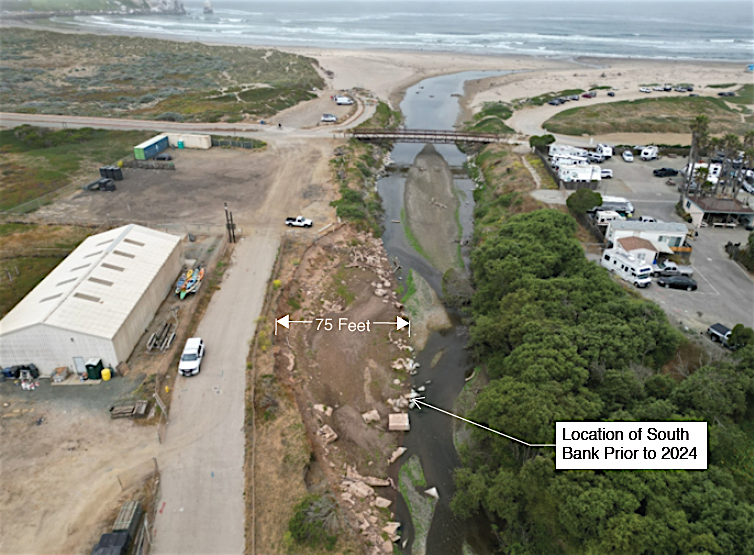
The City Council has approved an emergency fix on a stretch of Morro Creek adjacent to the Fishermen’s Gear Storage Facility where a football field-length slip is threatening the access road leading to the storage yard.
“During the 2023 storms and the 2024 high surf events, the southern banks of Morro Creek just east of the pedestrian bridge [Morro Creek Bridge] experienced erosion along an approximate 300-foot stretch,” reads a report from Public Works Director Greg Kwolek. “In some areas, approximately 70’ of ground was lost.”
The so-called “Morro Creek Bank Stabilization Project,” is likely to get worse this winter. “Without protective measures in place, future heavy rains, flooding, or high surf events this winter could further erode the bank and threaten the access roadway, potentially cutting off the only access to the Morro Creek Yard,” the report reads.
The Harbor Department has a small storage yard and a storage building on that stretch of the creek, and so too does the Coast Guard. But the city is also eyeing that area for a key element in its efforts to recycle treated effluent from its Water Reclamation Facility (WRF).
“The Yard is also the target location for two injection wells associated with the Recycled Water Project,” the report said.
The segment of Morro Creek from Highway 1 to where it spills onto the beach was constructed by the Army Corps of Engineers when it rechanneled the creek away from what was initially a Naval Base used during World War II to train for an amphibious landing in the Pacific Theater of the war.
Originally, the creek meandered through the power plant property, emptying near Coleman Beach before the new channel drained the wetland and made way for the Navy Base to be constructed.
Kwolek said the erosion continues to happen and fears it will worsen. “Erosion continues to progress slowly under current conditions, raising serious concerns about further significant loss during the upcoming rainy season or future high surf events,” he said. “Even a few additional feet of bank loss could compromise Coast Guard, Harbor, and commercial fishing operations.”
Though the road, which parallels the fence around the storage yards, has not yet been eroded, there isn’t much holding the creek bank together.
“Since the creek bank is comprised primarily of sand and currently unprotected, there is an imminent risk of property loss should upcoming rains or high surf events be severe enough,” the report said.
With this threat, Public Works staff recommended they proceed with an emergency declaration to expedite the work.
“Staff recommends proceeding with emergency creek stabilization work that could be implemented by late December 2025 or January 2026,” it said.
Staff estimated the costs for design of the fix and construction at some $700,000. They recommended the council authorize $868,000 for the overall project, leaving some wiggle room for contingencies.
It won’t be a simple fix, as several agencies on the state and federal level have jurisdiction. “The project area lies within a riparian zone regulated by the U.S. Army Corps of Engineers, California Department of Fish & Wildlife, and the Regional Water Quality Control Board,” the report continued. “Each agency provides emergency authorization procedures that allow immediate stabilization work when an imminent threat to property or essential public services exists under CEQA.”
CEQA stands for the California Environmental Quality Act and is the guiding law for projects done in environmentally sensitive areas, like a creek. They have a plan of action for getting through the bureaucratic hurdles.
“The city would notify USACE [Army Corps] and seek authorization under Regional General Permit 63 for emergency protection and repair activities. Work may begin once the District Engineer confirms the activity qualifies,” the report said.
The water board is next. “Staff would file a Notice of Intent and applicable fee prior to work initiation. Construction must commence within 7 days of submittal,” according to the report.
Fish & Wildlife must also be notified. “Notification is submitted within 14 days of starting work, followed by a post-project report.”
If they hit a snag at any of these agencies, they plan to come back to the City Council.
“Staff intends to advance the project as far as possible through these emergency processes to allow prompt stabilization before the storm season,” the report said. “If agency requirements or project scope exceed what can be approved under emergency provisions, staff will return to council for further direction.”
Declaring an emergency would let the city bypass the normal process of putting together a bid package and soliciting bids before awarding a contract. It would also cover them in case of complaints.
“An emergency declaration by the City Council is recommended to allow staff to act quickly to protect critical infrastructure and maintain access to the Morro Creek Yard,” the report said. “The declaration enables the city to bypass normal competitive bidding procedures and procure materials and services on a sole-source basis if needed. It also provides a clear administrative record supporting the use of emergency permitting provisions under CEQA and with state and federal regulatory agencies.”
A temporary fix should buy them time to develop a permanent solution, which would have to undergo the normal permitting and bidding processes and be much more complicated to get done.
“Temporary stabilization methods could include the placement of large removable cofferdams or sand/water-filled bags using products such as TrapBags, or Geotubes,” the report said. “However, the measures would be temporary and are estimated to cost $150,000 to $250,000 for installation. Removal costs and future permanent solutions would be at additional cost.”
According to Caltrans, “A cofferdam is a retaining structure, usually temporary in nature, which is used to retain water and support the sides of excavations where water is present. These structures generally consist of: (1) vertical sheet piling, (2) a bracing system composed of wales, struts, or tiebacks, and (3) a bottom seal course to keep water from piping up into the excavation or to prevent heave in the soil.”
Cofferdams are designed to “control the intrusion of water from a waterway and/or the ground,” Caltrans said.
Back in the 1990s, the city once attempted to install a cofferdam using sheet piles to stop similar erosion of the creek bank at Lila Keiser Park that threatened to eat into the west softball field.
This temporary fix is pretty involved. “The proposed emergency work would involve installation of rock slope protection along the toe of bank with potentially geogrid and soil in alternating layers to more permanently stabilize the creek bank,” Kwolek’s report said. “Native vegetation would also be used to help stabilize the creek bank and also enhance wildlife habitat in the area.”
So where’s the money for this coming from? The city intends to tap into unspent emergency funds allocated for those same 2023 and 2024 storms and to divert monies from another project.
“The Morro Creek Bank Stabilization Project will be funded through the Storm and Flooding Damages — Facilities/Equipment Repairs Project available balance, and by reallocating previously appropriated project funding from two other projects: Storm and Flooding Damages — Pavement Repairs Project and Juniper/Elena Emergency Storm Drain Repair Project,” the report said.
The money in that storm repairs fund was allocated in the 2022-23 and 2023-24 fiscal year budgets; and the Juniper/Elena Street storm drain project was funded by emergency reserves from 2020-21 and 2022-23 fiscal years.
In the report, they list $174,000 from the storm and flooding damages facilities/equipment repairs; $610,000 out of the storm and flooding damages pavement repairs; and, $83,000 from the Juniper/Elena storm drain job.
And since the site is potentially to be used for the WRF recycling wells, Kwolek said they would look into using some of that project’s money for this repair and would also see if they can get funding from the “Central California Joint Cable/Fisheries Liaison Committee and the U.S. Coast Guard. Additionally, staff will pursue available grant opportunities for General Fund reimbursement.”
The expenditures budget includes $75,000 for design and engineering; $125,000 for “regulatory compliance;” $500,000 for construction; and, $168,000 for contingencies.
Featured Image: This photo shows the extent of the erosion along a 300-foot section of Morro Creek. Photo courtesy City of Morro Bay