Council authorizes applications for up to $11 million in funding to help mobile home and RV park
The City of Morro Bay will seek grant funding to see if it can help out some neighbors who are having issues with their water and wastewater systems.
The City Council has authorized the Public Works Department to move forward with applying for two state grants with the goal of eventually hooking up the Rancho Colina Mobile Home and RV Parks to the city’s systems and help them come into compliance with state regulations.
According to a report from Public Works Director Greg Kwolek, Rancho Colina is a 69-space mobile home park and a 57-space RV park located at 1045 Atascadero Road, about a half mile east of the city limits in the SLO County jurisdiction.
The parks have their own drinking water and sewer collection and treatment systems, but have come under fire from the state in recent years.
“Rancho Colina has received several wastewater violations notices from the state due to its failing infrastructure,” the report said. “To bring the wastewater system into compliance with their new general permit for wastewater treatment, the Rancho Colina Wastewater Treatment Facility requires significant and expensive upgrades and repairs.”
That state agency is the Regional Water Quality Control Board, the same outfit that first ordered the city and Cayucos Sanitary District in 1993 to upgrade their jointly owned treatment plant, situated about a mile west of Rancho Colina on Highway 41 (Atascadero Road).
Instead of the costly repairs and upgrades, the report said the water board suggested the parks connect to Morro Bay’s systems, and they’d even help pay for it.
“The state offers financial incentives to larger wastewater systems, who allow smaller systems to consolidate,” Kwolek said. “These incentives take the form of grants to complete other necessary upgrades in the larger system that enable consolidation.”
This apparently won’t simply be a matter of extending sewer pipes out to the parks. “Staff’s preliminary analysis indicates that to connect Rancho Colina, the city would likely need to complete upgrades to our wastewater system to accommodate the additional sewer flows,” the report continues. “The cost of this upgrade could be offset by the financial incentives offered by the state for consolidation with Rancho Colina.”
Rancho Colina was developed and opened in 1972, said the owner, Steve McElvaine, a former Districty 2 SLO County supervisor. McElvaine told Morro Bay Life that the sewer plant has been in continuous use since it was installed in 1972 and still works fine.
He is totally onboard with hooking up to the city’s water and sewer systems, something he’d proposed that over 20 years ago but had been rejected. The state’s water laws back then were pushing for small separated systems. Then the law changed and now they are pushing to consolidate these small systems, he added.
Paying for the hookups wasn’t affordable for them, but again, the law changed.
And once the water board decided Rancho Colina was a disadvantaged community, “it opened up a bunch of grant money to consolidation,” according to McElvaine.
He said the city has some major projects it has been working on, but has no funding to do, namely building a new water storage tank on the hilltop above Nutmeg Drive, and replacing the sewer main on Atascadero Road.
With the state saying the Rancho Colina project could be eligible for up to $11 million, McElvaine said hooking up Rancho Colina would leave a lot of money left on the table for these other projects. The beauty of this grant money, he said, is if they get it, they could do these other projects and leverage it on potentially more grants.
Ironically, when Morro Bay was looking for a site for its new treatment plant, Rancho Colina was one of the places they looked hard at and even started negotiations.
The idea was to move the treatment plant down Highway 41 to the Rancho Colina property, which is much larger than just the two parks, and build it there. Connecting the parks to the new plant would have been part of the plan, however, the two sides could not reach agreement (due to city demands) and the city ultimately decided to build its new facility clear across town at a site above the terminus of South Bay Boulevard.
So instead of a roughly 1-mile move due east, the new plant ended up being moved some 3.5 miles and considerably higher in elevation at an overall project cost of about $175 million.
It also required a revamping of the gravity-fed collection system, including two new lift stations and miles and miles of new pipes.
The parks’ water system, which draws groundwater from wells, reportedly has its own set of issues concerning both quality and quantity.
“Rancho Colina’s groundwater wells have elevated nitrate concentrations, and have nearly run dry during recent droughts, forcing Rancho Colina to truck in water from other wells in the Morro Basin,” the report said.
While high nitrates are a relative fix with such a small water system, the wells seem to be suffering the same problems as the ag and residential wells throughout the Morro Valley.
During the last prolonged drought, many wells dried up, and avocado growers were forced to severely trim their trees (stumping) and place them into a dormant state until the drought was broken.
The trees that survived seem to now be healthy again. The state has another grant program to help with this.
“The State also offers financial incentives for larger water systems to consolidate in small systems,” the report said. “Staff’s preliminary analysis indicates that to connect city water service and Rancho Colina, the city would likely need to complete upgrades within the existing water system. As with the wastewater example, the cost of this water system upgrade could be offset by financial incentives.”
As a mobile home park filled mainly with senior citizens, Rancho Colina has something going for it that makes this a potentially smoother proposition.
“In 2022, the Regional Water Quality Control Board contacted the City regarding the potential for Rancho Colina to connect to the City’s water and wastewater utilities,” Kwolek reported. “Since Rancho Colina is classified as a ‘disadvantaged community,’ there could be up to $11 million in grant funding available from the CWSRF [Clean Water State Revolving Fund — for the sewer work] and DWSRF programs [Drinking Water State Revolving Fund — for the water] to pay for infrastructure upgrades to the city’s water and wastewater systems and pipelines to connect Rancho Colina.”
McElvaine chuckles at this, noting that without the parks, the city isn’t eligible for these grant programs. He noted that about 20 years ago he brought in someone to do an estimate of what it would cost for them to hook up to the city and the estimate came in at about $300,000. He acknowledges that it would of course be considerably more now, but nowhere near $11 million.
With the council’s approval, the staff will now make formal application to the state for these grants, which the report estimated could be finalized about midyear. From there they would begin “evaluation to assess feasibility of the project,” Kwolek said.
Assuming it is feasible, they would then move into a design contract and eventually construction. But there’re no guarantees.
“At any point in the process, the city can opt to withdraw from this project,” the report said.
It’s unclear at this point whether the city would also seek to extend its city limits down Highway 41 to include Rancho Colina, but if it did, that would bring the RV park under city jurisdiction and the city’s 10% bed taxes, as well as a share of the property taxes for both parks into the city treasury.
Such a move would have to be done through the Local Agency Formation Commission or LAFCO. But McElvaine said he approached LAFCO, many years ago to see about being annexed into the city and at that time, they were against it because of the need to “leapfrog” over another large property, the Righetti Ranch, which sits between his property and the city limits.
He is not opposed to being annexed and acknowledges it could bring even more benefit to the city in the form of property and bed taxes, which he collects at the RV park and pays to SLO County.
The County’s Transient Occupancy Rate is 9% and the city’s is 10%.
He added that they already get some city services like police and fire response for emergencies.
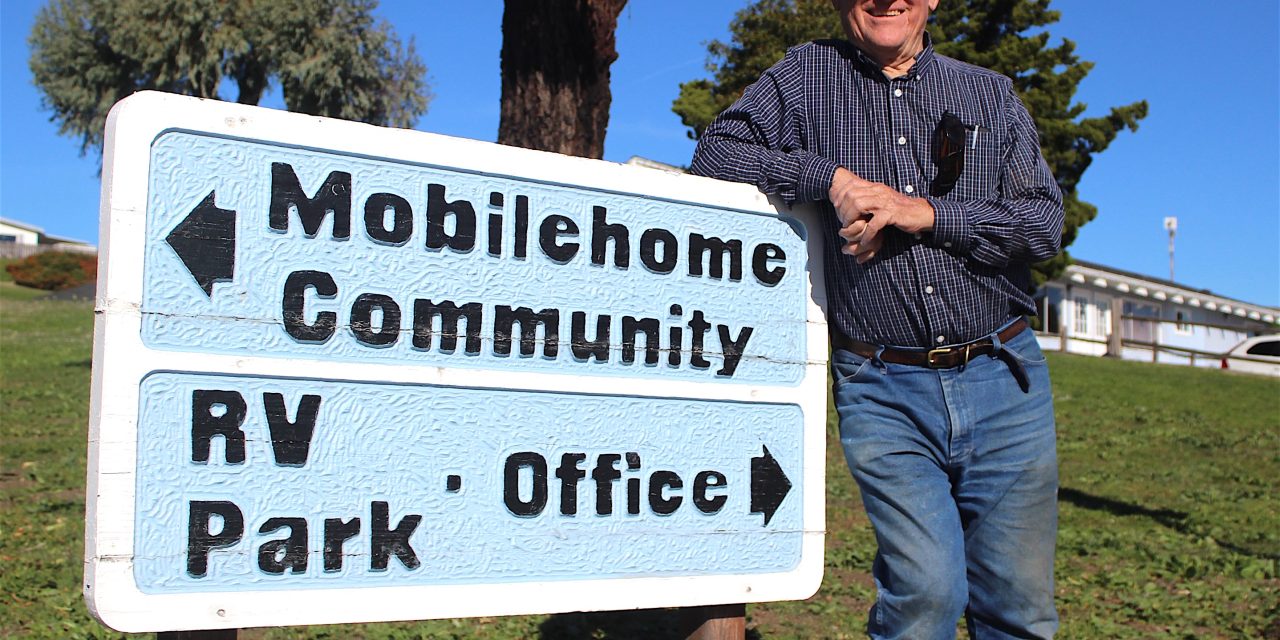
Feature Image: Steve McElvaine, owner of Rancho Colina Mobile Home and RV Park, poses next to the entrance sign to the parks, which were opened in 1972. Photo by Neil Farrell