Organization seeks to lease portion of Cayucos Water Reclamation Facility to build triage site after Morro Bay plant closure
An organization working to rescue sick and injured marine mammals may be finding a new home in Cayucos.
The Cayucos Sanitary District was expected on Nov. 20 to approve a conceptual plan to lease a portion of its Water Reclamation and Recycling Facility (WRRF) property on Toro Creek Road to the Marine Mammal Center to build a new triage facility.
The center is under the clock to find a new home after Vistra notified them they would have to vacate their long-time facility on the Morro Bay Power Plant property in Morro Bay.
The center, which is headquartered in Sausalito in the Bay Area, has been at the Morro Bay site since 2005, using it as a base of operations for volunteers to respond from anywhere in San Luis Obispo County when the public reports mostly seals and sea lions that have been discovered in distress.
The volunteers and center staff locate and evaluate each animal. If necessary, the critters are captured and taken to the Morro Bay facility, where they are stabilized. If they recover sufficiently, they are re-released back into he wild. If they need further treatment, they are transported to other, better-equipped facilities in Moss Landing or the home animal hospital in Sausalito. No matter, the ultimate goal is to return them to the wild.
Former power plant owner Duke Energy originally leased the small site on the roughly 100-acre plant. Duke also leased a site for Pacific Wildlife Care, which was built next door to the Marine Mammal Center’s facility.
The lease had been renewed a couple of times, even as the power plant was sold a couple of times before Vistra obtained it. Vistra, which is pursuing a Battery Energy Storage System or BESS on the power plant property, notified the center and PWC that they would have to move. PWC, which does similar work as the MMC but rescues birds and land mammals like possums, is currently building a new facility on donated land out by the San Luis Obispo County Airport and plans to move there. The clock is ticking for the MMC.
“We have 15 months — by the end of 2026,” said MMC’s Chief External Relations Officer and former CEO, Dr. Jeff Boehm, DVM.
That notification sent the MMC into search mode and they’ve looked at several other potential locations, including a closed teen center in Morro Bay on Atascadero Road and most recently at the Cayucos CSD’s Toro Creek Road plant.
In Cayucos, they found an agency willing to help them.
“Our board is supportive of their efforts and believes this could be a great long-term partnership as we both care for the long-term health of the Estero Bay and the life that inhabits it,” CSD Interim General Manager Will Clemens said back in August.
The CSD agreed to work with the MMC staff on possibly leasing a portion of their plant site, which has a solar energy farm on it, used to power the WRRF. Now, they have a conceptual plan, something concrete to work with.
“Approval of the attached conceptual site plan,” reads Clemens’ report, “is an initial step in determining the feasibility and will ensure that staff and MMC are on an acceptable path before expending additional resources. Approval of the conceptual site plan does not obligate
the district to enter into a ground lease.”
The conceptual plan lists a “team of collaborators” working on the new facility. They are Arris Studio Architects, Kirk Construction, Specialty Construction, Whittle Fire Protection, and The Wallace Group Civil Engineers, an engineering firm in SLO.
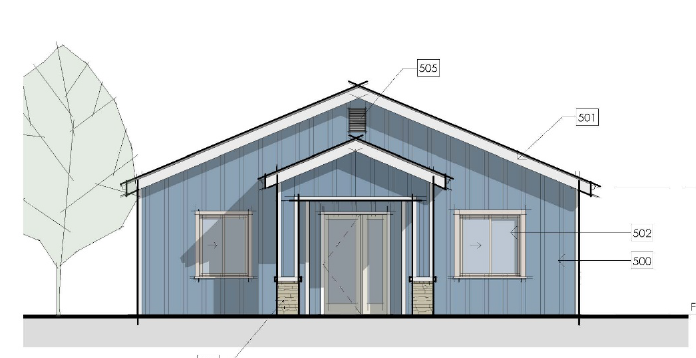
A site plan shows an initial three buildings — an office, storage shed, and “pen building” where the animals would be housed while at the facility. It shows a substantial parking area and future sites for a covered patio and a necropsy room.
Design of the buildings is similar to the ranch-style architecture that the CSD used for its treatment plant, something the CSD Board wanted to make sure it had to blend in with the WRRF’s ranch-style motif.
It also has fabric buildings instead of metal. The fabric would better deaden sound with less echo from the barking sea lions and stay cooler in summer than metal. Being naturally cooler means they would not need forced ventilation.
That type fo construction would also be cheaper and faster to build, according to the plan.
Assuming the conceptual plan was acceptable to the CSD Board, they can now move forward with a more official project. Given the location, the County Planning Department would act as the permitting agency for a formal project review.
They should get a good reception with the county, as Boehm said county supervisors, as well as the staff, were very supportive of the center and the vital work they do for the marine environment, even though they were unable to find a location.
Feature Image: A conceptual design is shown of the Marine Mammals Center’s triage facility on Toro Creek Road. Image courtesy Cayucos Sanitary District